Fleetwood, Surrey

Finding the right part of Fleetwood matters

Fleetwood can offer families space, established neighbourhoods, schools, parks, everyday convenience, and improving transit connections. But it is not one uniform neighbourhood.

A quiet interior street can feel completely different from a home only a few blocks away near a major corridor. The housing, school catchment, parking, access, redevelopment around you, and the way the property functions can all change whether a home truly works for your family.

Fleetwood can be a strong fit, but location within it matters

Fleetwood is a strong option for families who want more living space, access to schools and parks, practical shopping, and a residential setting that still connects reasonably well with the rest of Surrey.

The experience changes from one part of Fleetwood to another. A home may be close to a school, park, shopping plaza, or future SkyTrain station and still be the wrong choice because of traffic exposure, awkward access, poor parking, surrounding development, or a layout that does not support the family living there.

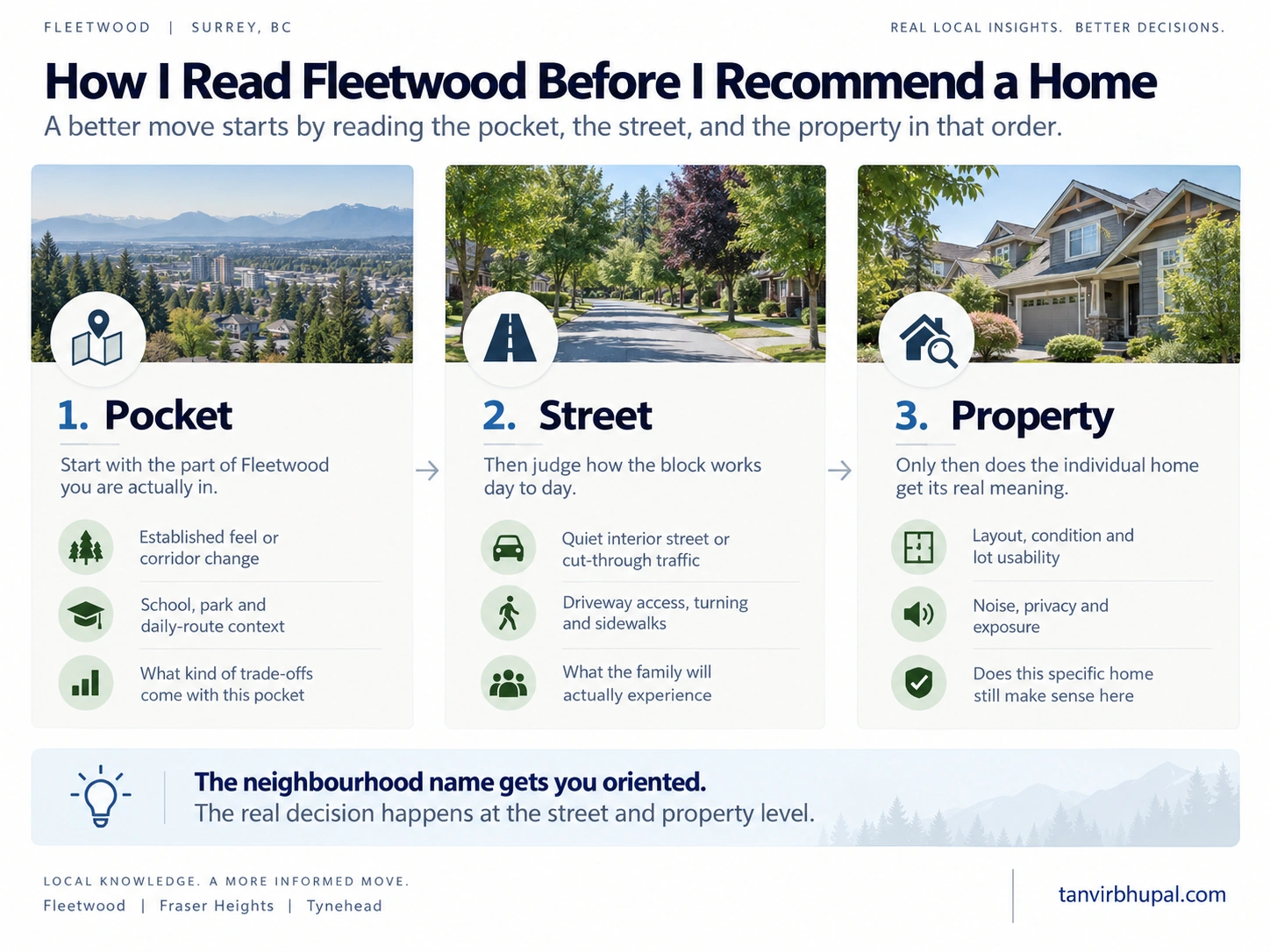
The most useful way to evaluate Fleetwood is at three levels:

The pocket

What type of housing, access, schools, parks, traffic, and future change shape the surrounding area?

The street

Is it quiet or active? How do vehicles move through it? What happens during school hours, rush hour, or nearby construction?

The property

Do the parking, layout, outdoor space, condition, storage, and future flexibility actually support your life?

Fleetwood could be a strong fit for your family, but the part of Fleetwood you choose will matter just as much as the area itself.

Two nearby homes can offer very different lives

A listing can show the distance to a school, park, grocery store, or transit stop. It cannot fully show how the street feels at 8:30 in the morning, how difficult it is to leave the driveway during rush hour, where visitors park, or how much road noise reaches the backyard.

Fleetwood includes quiet interior streets, cul-de-sacs, established detached-home areas, townhouse communities, active corridors, school traffic, construction zones, and locations that may change significantly as new transit and housing arrive. That variation is why two homes that appear almost identical online can create very different day-to-day experiences.

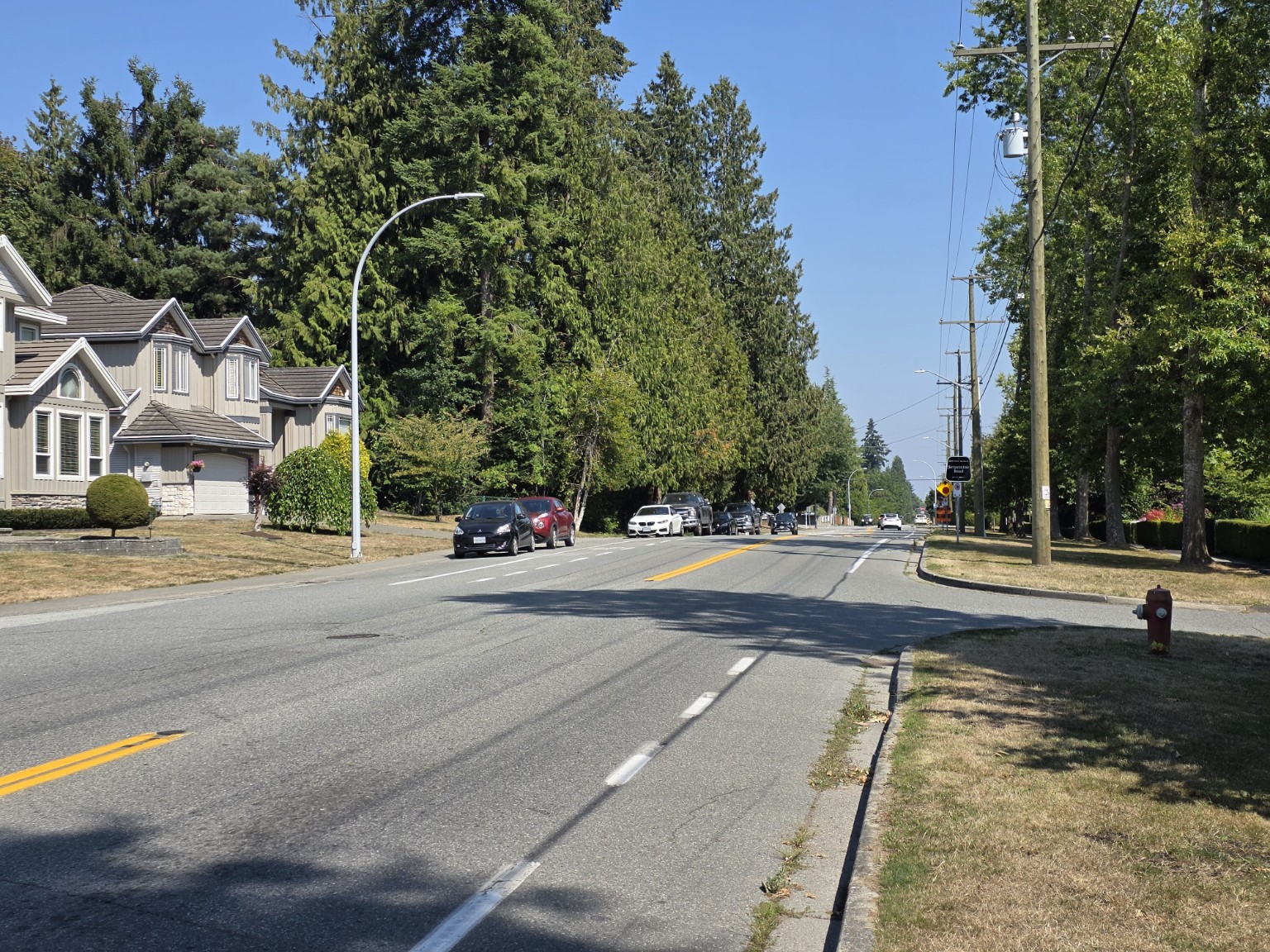
I pay close attention to the relationship between the property and nearby roads. Living directly on or close to a major route is not automatically wrong, but buyers should understand the trade-off before assuming the location is simply convenient. My guides to living on or near 88 Avenue and evaluating a home near 156 Street go deeper into those differences.

The best part of Fleetwood for your family may not be the part that initially looks best on a map.

Use pocket names as a starting point, not a conclusion

Fleetwood does not divide neatly into a collection of official micro-neighbourhoods. Some names are recognized locally, some come from older planning areas or developments, and some are used loosely in real estate marketing.

Names such as Berkshire Park, the established residential areas around Fleetwood Park, and the locally recognized Coast Meridian Estates area can help organize a search. Areas closer to Fraser Highway and future transit have a different set of considerations than quieter sections farther from the main corridor. Toward the eastern side of Fleetwood, some buyers also look for larger lots, mature homes, or properties closer to the agricultural edge.

Those labels are useful only to a point. Boundaries can be approximate, and one street within a recognized pocket may feel noticeably different from the next. The actual road, access pattern, surrounding housing, and property still need to be evaluated individually.

For a broader orientation, read where Fleetwood actually begins and ends. For a closer look at one quieter residential area, see my guide to the area around Berkshire Park.

Mature streets and larger lots come with their own questions

Fleetwood's established detached-home areas can offer features that are difficult to reproduce in newer developments: mature streets, wider lots, private outdoor space, generous parking, storage, and homes that may adapt well to children, extended family, or working from home. Those are meaningful advantages, but an older home should not be treated as better simply because it sits on more land.

Condition can vary widely. Buyers may need to consider the roof, drainage, plumbing, electrical systems, windows, heating, past renovations, and whether additions or suites were completed properly. A renovated interior can still hide expensive work or a layout that never functioned particularly well.

The layout deserves the same attention as the building systems. Some established homes provide useful separation, comfortable bedrooms, good storage, and flexible lower levels. Others have dark additions, awkward stairs, poor suite separation, or square footage that looks impressive but does not improve daily life.

In Fleetwood's established areas, the strongest value often comes from the combination of street, lot, layout, condition, and future flexibility, not from the size or age of the home alone.

Buyers comparing mature homes may find it useful to read about larger lots and mature homes near 168 Street and 84 Avenue, as well as the renovated-home trap in mature Fleetwood pockets.

Newer does not automatically mean easier

Newer townhomes, duplexes, and redevelopment-oriented housing can appeal to families who want modern layouts, newer systems, less immediate maintenance, and closer access to shops or transit.

The practical trade-offs deserve equal attention. A newer home may have tighter parking, less storage, smaller outdoor areas, more stairs, limited visitor parking, or less privacy. A den or flex room may not function like a real bedroom. A modern kitchen may be impressive during a showing while the garage, entry, and storage create frustration every day.

For strata properties, the monthly fee is only one part of the review. Bylaws, insurance, contingency planning, maintenance history, pet and rental rules, parking rights, and the way the complex is managed may matter just as much as the age of the home.

Newer housing can reduce some maintenance concerns, but buyers still need to decide whether the parking, privacy, outdoor space, rules, and layout genuinely support their daily life.

My townhome versus detached-home comparison and guide to older Fleetwood townhouses versus new builds explore these choices in more detail.

Function matters more than the feature list

Bedrooms, bathrooms, lot size, and finished square footage are useful filters. They do not tell you whether the home will support the way your family actually lives.

I look at questions such as:

  • Where will the household's vehicles and visitors actually park?
  • Can children move safely between the home, yard, sidewalk, and street?
  • Would an aging parent be comfortable with the stairs, entrance, bedroom, and bathroom access?
  • Does a suite offer real privacy and separation, or only a second kitchen?
  • Is the outdoor space usable, private, and visible from the main living area?
  • Is there enough storage for sports equipment, seasonal items, strollers, tools, or work needs?
  • Will the layout still work as children grow or family responsibilities change?

A home should not need to be perfect forever. It should make sense for the next stage of life and leave enough flexibility for the changes you can reasonably anticipate.

A larger home is not necessarily a more useful home. The better choice is the one that supports your routines now and gives you room to adapt later.

A catchment is only one part of the school decision

Schools often shape a family's Fleetwood search. Catchments can affect assignment, transportation, before and after-school routines, and how narrowly a buyer is willing to look. Fleetwood Park Secondary, Enver Creek Secondary, Walnut Road Elementary, Woodland Park Elementary, and Coyote Creek Elementary are some of the schools families may encounter while comparing different parts of the area. They are useful orientation points, not a ranking of which location is best.

School reputation should not be treated as a guarantee. Programs, enrolment conditions, boundaries, and a family's own needs can change. Families should confirm the current catchment for a specific address through the Surrey School District before relying on it. A home in a sought-after catchment may still be the wrong choice if it sits on an uncomfortable road, creates a difficult commute, lacks parking, or does not function well for the family.

Schools matter, but the right decision comes from looking at the catchment, daily routine, street, and property together.

For a deeper framework, read how to compare Fleetwood elementary schools and the practical differences between the Enver Creek and Fleetwood Park Secondary catchments.

Current catchments should be verified using the Surrey School District Catchment Locator.

Convenience depends on the address

Fleetwood offers neighbourhood shopping, parks, schools, community facilities, and access to recreation. Fleetwood Park includes play areas, a spray park, gardens, and nature trails. Fleetwood Community Centre provides registered and drop-in programming for different ages, and the Surrey Sport & Leisure Complex adds swimming, skating, fitness, and other recreation options.

That does not make every Fleetwood address equally walkable. Many daily routines still work better with a vehicle. A destination may look close while a major road, indirect entrance, limited crossing point, or uncomfortable walking route makes the trip less practical. Being close to shopping can also bring traffic, delivery activity, density, or noise.

Convenience should be judged from the property itself: how you enter and leave, where you need to go each day, whether children can travel comfortably, and which routes you will actually use.

For more detail, explore walkability around Frost Road and my guide to Fleetwood's green spaces and off-leash options.

Better connectivity will also bring change

The Surrey Langley SkyTrain extension is under construction along Fraser Highway. The project currently anticipates service beginning in late 2029. Stations relevant to Fleetwood include 152 Street Station, Fleetwood Station near 160 Street, and Bakerview-166 Street Station.

Future rapid transit may improve how Fleetwood connects with other parts of Surrey and Metro Vancouver. It may also support new housing, shops, services, and a more defined town centre over time. Those benefits come with trade-offs. Construction, road changes, increased density, redevelopment, changing traffic patterns, and evolving street character will not affect every property in the same way.

A home's relationship to transit matters, but so do its exact street position, access, noise exposure, surrounding land use, and what may be developed nearby. A shorter walk to a station does not automatically make a property more suitable for a family or a better purchase.

Future transit may improve how Fleetwood connects with the rest of Surrey and Metro Vancouver, but proximity alone does not make a property a better purchase.

Buyers considering the corridor can continue with my guides to buying near 152 Street Station, family life near Fleetwood Station, and the changes planned for Fleetwood over the next several years.

Transit timing and station information were reviewed against the Surrey Langley SkyTrain project website. Land-use planning should be confirmed through the City of Surrey Fleetwood Plan, which continues to be updated.

Fleetwood tends to work best for families who value balance

Fleetwood is a strong fit for buyers who want residential surroundings, practical access, more housing choice, and the possibility of finding a home that can support children, extended family, work, storage, and outdoor life. It can also suit buyers who are comfortable making a careful property-level decision rather than assuming one school, station, or pocket name tells the whole story.

Fleetwood will not suit every buyer

It may be a weaker fit for someone who wants a highly walkable urban lifestyle, expects every street to feel quiet and settled, or wants newer construction, a large private lot, generous parking, and minimal compromise in one property. Buyers who are uncomfortable with construction, density, changing traffic, or neighbourhood evolution may prefer a more established location farther from the main growth corridors.

The purpose is not to convince every family to choose Fleetwood. It is to help the right family recognize the fit, while giving others permission to keep looking.

A local perspective, through more than one stage of life

I grew up in Fleetwood and later returned to raise my own family here. I notice the area differently now than I did as a child. I pay more attention to school-day traffic, how safely a street works for children, whether a layout can accommodate parents, where everyone will park, and how nearby growth may change daily life. That experience informs my advice, but the decision still has to begin with what works for your family.

Common questions about living in Fleetwood

Is Fleetwood a good place for families?

Fleetwood can be a strong fit for families who value residential streets, schools, parks, practical shopping, and a range of detached and townhome options. The experience varies significantly by pocket, street, and property, so the area should not be judged as one uniform neighbourhood.

What are the best parts of Fleetwood?

There is no single best pocket for every household. Some families prioritize quieter interior streets and established detached homes. Others prefer newer housing, lower maintenance, or easier access to shopping and future transit. The better question is which location best supports your family's routines, budget, commute, and long-term needs.

Is Fleetwood walkable?

Walkability depends heavily on the address. Some homes are close to schools, parks, shopping, and transit, while many daily routines still work better with a vehicle. Major roads, crossings, indirect entrances, and the comfort of the route matter as much as map distance.

Should I buy close to a future Fleetwood SkyTrain station?

Proximity may improve transit access, but it can also bring construction, density, noise, traffic changes, and redevelopment. Buyers should evaluate the specific street, surrounding land use, access, and intended use of the home rather than assuming the closest property is automatically the best choice.

How should families compare Fleetwood school catchments?

Start with the current catchment for the specific address, then consider the child's needs, school-day transportation, childcare, commute direction, and the suitability of the home and street. Catchments and enrolment conditions should be confirmed directly with the Surrey School District.

A clearer way to choose

Talk through where in Fleetwood your family may fit best

You may be deciding whether Fleetwood is right at all, narrowing a few streets, or comparing a particular home. We can look at the location, property, trade-offs, and what the decision needs to support next.

Sources and verification: Planning, transit, school, and facility information was reviewed against official City of Surrey, Surrey Schools, and Government of British Columbia sources. Property-specific details should be confirmed before a purchase decision. Fleetwood community profile · Fleetwood Plan · Surrey Langley SkyTrain · SkyTrain stations · School Catchment Locator · Fleetwood Community Centre · Fleetwood Park · Surrey Sport & Leisure Complex.